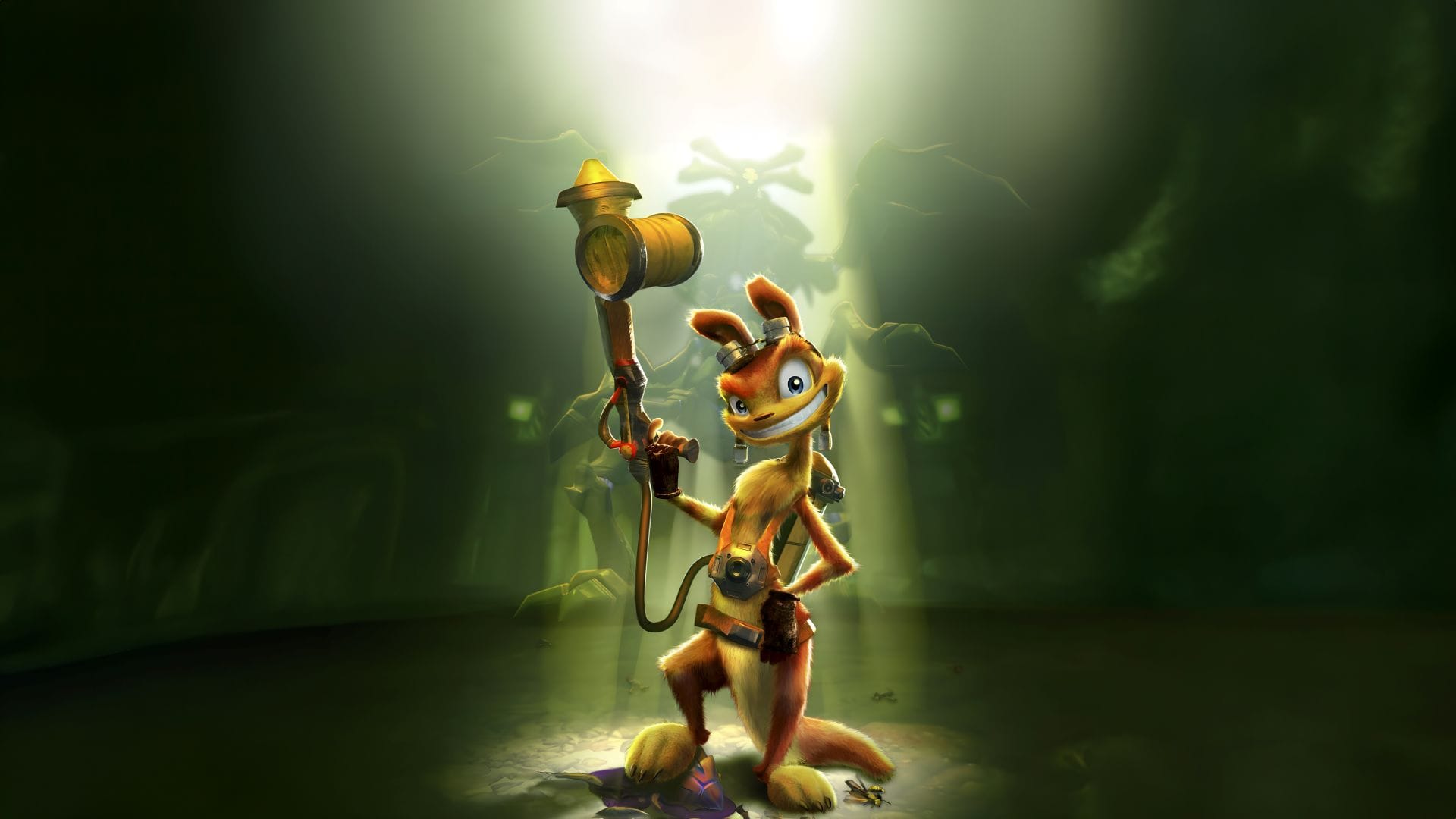
Remember 2006? If you were walking around with a PlayStation Portable (PSP) in your pocket, you weren’t just a gamer—you were a tech pioneer. The PSP wasn’t just another handheld; it was the ultimate status symbol. With its sleek glossy finish and that gorgeous widescreen LCD, it felt like the future had finally arrived.
But let’s be real: beyond WipEout and Ridge Racer, the early launch library felt a bit like a ghost town of lackluster PS2 leftovers. Sony desperately needed a killer app to prove that this little machine could handle a true triple-A experience. That’s exactly where Daxter comes in. In this review, you will find out if our favorite orange Ottsel still sets the gold standard for what a portable platformer should be.
Story Overview
Daxter finds himself in a bit of a pickle—Jak is MIA, and the city is crawling with Metal Bugs. Instead of wallowing in despair, Daxter lands a job with Osmo, the owner of a local pest control business. It’s a brilliant narrative pivot. It turns a legendary hero-in-the-making into a blue-collar exterminator just trying to stay afloat in a city that’s rapidly going to the dogs (or bugs, in this case).
The plot doesn’t try to reinvent the wheel or drown you in complex lore. It’s a lean, mean storytelling machine that focuses on Daxter’s desperate, often hilarious attempts to rescue Jak while accidentally becoming the city’s premier bug hunter. Honestly, the Jak and Daxter franchise was never really celebrated for its deep philosophical themes, and this game leans into that simplicity beautifully.
The focus here is on character-driven comedy. Daxter’s bravado is constantly undermined by his own clumsiness, leading to some of the funniest cutscenes on the PSP. What really makes the story stick is how it justifies Daxter’s growth.
He isn’t just jumping around because the script says so; he’s driven by a genuine, albeit often hidden, loyalty to his partner. Watching him transform from a reluctant coward into a somewhat-competent exterminator is a total blast. The dialogue is snappy, the jokes land more often than they miss, and the pacing is relentless.
Gameplay

Ever feel like the Jak series went through a bit of an identity crisis? While Jak II and Jak 3 pivoted hard into Grand Theft Auto with hover-cars, Daxter performs a glorious U-turn. It’s a love letter to the pure platforming that made the original Precursor Legacy so iconic. If you’ve missed the thrill of precision jumping without a dozen soldiers shooting at your back, you’re in for a treat.
The shift in perspective is what makes the gameplay feel so visceral. Because you’re playing as a diminutive Ottsel rather than a tall teenager, the entire world feels monumental. A simple ventilation shaft becomes a complex gauntlet, and a library shelf feels like a sheer cliff face. Ready at Dawn nailed the physics here; Daxter feels light, nimble, and incredibly responsive.
Since Daxter doesn’t have Jak’s combat prowess, he relies on his wits and his pest-control gear. You start with a simple fly swatter for melee—which feels surprisingly punchy—but the real star is the Bug Spray Tank. This isn’t just for killing creepy-crawlies; it’s a multifaceted traversal tool that changes how you interact with the environment.
The tank eventually gets upgrades that turn Daxter into a miniature powerhouse. The Hover Nozzle is a total game-changer, allowing you to flutter across gaps that would otherwise be impossible. It adds a layer of verticality to the levels that feels fresh and satisfying. IMO, the level design here is actually tighter than some of the console entries because every platform is placed with surgical precision :).
One of the smartest design choices here is the mission structure. The levels are designed in digestible, bite-sized chunks, and the variety is also top-notch. One minute you’re navigating a high-speed transit system, and the next you’re sneaking through a posh hotel. You can clear a sub-section in ten minutes, feel a sense of accomplishment, and pop the PSP into sleep mode, making it the ultimate bus stop game.
Ever feel like a game is taking itself a bit too seriously? Daxter sidesteps that trap by leaning into pure, unadulterated whimsy through its Dream Sequences. The parodies here are spot-on, poking fun at the tropes of the era with a wink and a nudge. You’ll find yourself dodging bullets in a green-tinted lobby or holding the line against a literal sea of bugs on a Scottish battlefield. The developers didn’t just skin these levels to look like movies; they captured the cinematic language of the films they were spoofing.
These segments function as a brilliant palate cleanser, shifting the gameplay from precision platforming to rhythm-based combat and quick-time events. The parodies here are spot-on, poking fun at the tropes of the era with a wink and a nudge. The developers didn’t just skin these levels to look like movies; they captured the cinematic language of the films they were spoofing. IMO, the Matrix parody remains the gold standard for how to do a movie reference in a video game without it feeling cringeworthy or forced. It’s just pure, distilled fun that doesn’t overstay its welcome.
Level Design

One of the biggest pitfalls of early mobile gaming was repetitive scenery, but this game suffers from no such issue. Each level has a distinct visual identity and a unique set of hazards that demand a different approach. Whether you’re navigating the clanking machinery of a fish cannery or the lush, treacherous greenery of an emerald isle, the game constantly throws fresh aesthetics at you.
I particularly love how the levels are designed around Daxter’s specific moveset. You’ll find yourself using the hover nozzle to cross massive gaps or scurrying through pipes that Jak would never fit into. It’s Environmental Storytelling 101—the world feels built for an Ottsel, not just a human character shrunk down to fit the screen.
While the stages are technically segmented to keep the PSP’s memory from exploding, they feel incredibly dense and purposeful. There is zero “filler” space here. Every platform, every enemy placement, and every collectible feels like it was placed with surgical precision to maximize the fun factor.
The compromise of having loading zones between areas actually works in the game’s favor for handheld play. It creates natural “stop-and-go” points, allowing you to finish a specific challenge during a quick break without feeling like you’re abandoning a marathon. Why can’t more modern “open-world” games learn that less is sometimes way, way more? The Fish Cannery level still gives me nightmares about slippery floors, but in the best way possible.
The most impressive feat is how these levels maintain their high-fidelity detail without tanking the frame rate. The lighting is moody, the textures are crisp, and the atmosphere is thick enough to cut with a fly swatter. Why did more developers not take notes from this? It’s a perfect example of working with hardware limitations rather than against them. It’s the kind of polish that makes you forget you’re playing on a handheld and not a home console.
Graphics & Sound

In 2006, seeing Daxter running on a handheld felt like catching a glimpse of an alternate dimension. It didn’t just look “good for a PSP game”—it looked like a high-budget PlayStation 2 title that someone had somehow shrunk down and stuffed into your pocket.
The visual fidelity goes way beyond just character models. The environmental lighting is surprisingly sophisticated, especially when you’re lighting up dark corners with your flamethrower. You’ll see dynamic shadows and vibrant particles that make the world feel alive rather than static.
The textures on Daxter’s fur and the metallic sheen of the bugs have a level of detail that was frankly unheard of for the hardware. Even the draw distance is impressive; looking out over Haven City from a high vantage point gives you a sense of scale that makes the game feel much larger than its “bite-sized” level design would suggest. It’s the kind of polish that makes you wonder if there was some hidden GPU hidden in the UMD drive.
But let’s talk about the soundscape, because the audio design is just as punchy as the graphics. The game features full voice acting from the original cast, which is a massive win for consistency. Hearing Max Casella’s iconic, fast-talking delivery coming out of the PSP’s speakers really sells the idea that this is a real Jak game, not some budget spin-off.
Why did this look and sound so much better than the competition? It comes down to a “no compromises” philosophy. Instead of stripping the soul out of a console port, Ready at Dawn built a tailor-made experience. They understood that on a smaller screen, sharp contrast and exaggerated animations matter more than raw polygon counts.
The result is a game that still holds up visually today. If you fire this up on a modern display or a handheld emulator, you’ll be shocked at how clean the art direction is. It’s a testament to the fact that great art and smart engineering beat raw power every time. BTW, seeing Daxter’s ears flop around while he’s hovering is still one of the most satisfying bits of animation ever put on a handheld. 🙂
Final Verdict
So, where does this leave our favorite orange “pest exterminator”? Daxter isn’t just a great handheld game; it’s a masterclass in how to spin off a beloved franchise without losing its soul. It manages to capture that elusive “lightning in a bottle” feeling that characterized the early PS2 era while being perfectly tailored for short bursts of play.
While other games from 2006 feel like relics of a bygone age, this one remains surprisingly fresh. The level design holds up, the combat is satisfyingly tactile, and the performance is a testament to what happens when developers actually care about the hardware they’re working on. It bridges the gap between Jak 1 and Jak II perfectly, making the overarching story feel just a little more complete.
If I had one minor gripe to pick with this otherwise stellar package, it’s that the credits roll a bit too soon. Don’t get me wrong, the pacing is fantastic, but the game could’ve been longer. If you’re a platforming veteran, you’ll likely breeze through the main story in about eight to ten hours. However, if you’re looking for a laid-back break from those modern 70+ hour open-world behemoths, this is actually a blessing.
Daxter is a tight, focused adventure that doesn’t overstay its welcome or pad the runtime with boring fetch quests. Whether you’re looking to scratch that nostalgia itch or you’re a newcomer wanting to see why people were so obsessed with the PSP, Daxter is the ultimate proof that the sidekick can indeed carry the show.
Verdict
Daxter
Excellent