Key Takeaways
| Pros | Cons |
| Stunning 16-bit Visuals: Features some of the best pixel art and floor textures on the PC Engine. | Brutal Difficulty Spikes: Losing your power-ups before a boss makes the game feel nearly impossible. |
| Objective-Based Gameplay: Destroying generators adds a welcome layer of strategy over mindless killing. | Unfair RNG: Randomly generated mazes can occasionally spawn you into “dead on arrival” traps. |
| Technical Masterclass: Smooth performance and vibrant colors that rival (and sometimes beat) the SNES. | Frustrating Save System: Relying on passwords in 1994 feels like a chore, especially with no battery backup. |
| Iconic Boss Design: Massive, screen-filling guardians that provide a satisfying challenge. | Short Campaign: Veteran players can blast through the entire game in a very short afternoon. |
Ever wondered where Bomberman’s explosive legacy actually began? It might surprise you that our spherical hero started life as a mere tech demo for a BASIC compiler. He eventually morphed into a household name on the NES, but the PC Engine remains his most natural habitat. Hudson Soft didn’t just build a library; they forged a legendary identity around a little guy with a short fuse and a penchant for grid-based demolition.
While Bomberman ’93 set a high bar for the PC Engine, Bomberman ’94 feels like Hudson Soft finally took the training wheels off. In this review, you’ll find out whether this game is still the ultimate 16-bit send-off for the system.
Story Overview
While earlier games in the series felt like a simple series of basement skirmishes, Bomberman ’94 cranks the cinematic stakes to eleven. In a display of sheer villainous overkill, Bagura and his robotic army invade Planet Bomber and literally shatter the world into five distinct chunks. It’s a bold narrative pivot that sets the stage for almost every modern Bomberman adventure that followed.
Imagine waking up and finding your home has been reorganized into a cosmic jigsaw puzzle! Our hero, the ever-resilient White Bomberman, steps up to the plate once again to save the day. But this isn’t just a stroll through the park. To mend the world, you have to bypass Bagura’s high-tech security systems and face off against his lieutenants.
Each of the five fragments represents a unique biome, and let’s be honest, Bagura didn’t make the retrieval process easy. The shards are tucked away behind technological barriers, protected by bosses that would make even a veteran gamer break a sweat.
It’s an classic underdog story: one little guy against a planetary-scale invasion force. The narrative adds a layer of genuine motivation to the arcade action. Every time you restore a shard, you get a small sense of victory that makes the mounting difficulty feel worth the effort.
In previous entries, your mission was simple: blow up every living thing on the screen and find the hidden trapdoor. It was a classic “exterminate and evacuate” loop. However, Bomberman ’94 tosses that old playbook into the blast furnace. Now, your primary objective shifts to a more tactical “search and destroy” mission involving the planet’s power source.
Gameplay

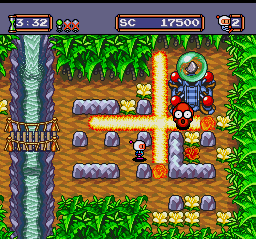
Instead of hunting down that one stray slime hiding in a corner like previous games, you now need to track down and demolish specific mechanisms. these machines power the energy barriers that cage the planet’s shards. Once you’ve wrecked the tech, the barrier drops, the shard is yours, and the exit opens. It sounds straightforward, but it completely changes the pacing of every single stage.
This new objective-based flow gives you a genuine choice in how you tackle the maze. Are you feeling bold? You can ignore the enemies entirely and blitz the generators to clear the stage in record time. On the other hand, if you’re feeling underpowered, the classic “scorched earth” policy still applies. You’ll want to clear the room to hunt for essential power-ups like the vest or the remote detonator.
If you manage to avoid death and stack your power-ups, your blast radius becomes absolutely monstrous. You can clear a massive chunk of the map with a single well-placed explosive, turning entire hallways into a fiery graveyard for Bagura’s goons.
But here’s the kicker: the more powerful you are, the more dangerous you become to yourself. With a maxed-out arsenal, it’s incredibly easy to accidentally corner yourself or miscalculate a chain reaction. I can’t tell you how many times I’ve “aced” a level’s layout only to get caught in the tip of my own flame because I got a little too trigger-happy.
After dodging fireballs and navigating frozen tundras, you’re eventually going to run face-first into the big guys. The bosses in Bomberman ’94 follow a specific logic—a rhythmic loop of attacks that you have to decode before you can even think about going on the offensive.
If you jump the gun and drop a bomb too early, you risk blocking your own escape route. It’s all about patience and precision. Once you’ve memorized the tells—a specific flash of the eyes or a shift in stance—there is no better feeling in this game than landing that final, killing blast on a boss that’s been bullying you for ten minutes.
In the early 90s, the “luxury” of an internal battery backup was often reserved for massive RPGs. Since Bomberman ’94 lives on a slim HuCard, we have to deal with the ancient ritual of the password system. It’s a nostalgic trip, sure, but it also highlights just how unforgiving this era of gaming could be when things went south.
You’ll find yourself scribbling down strings of characters just to ensure your progress doesn’t vanish into the ether when you flip the power switch. If you burn through your lives and hit a Game Over, the password will let you return to the area, but you’ll start as a naked Bomberman. All those speed shoes, extra bombs, and vest power-ups? Gone. Trying to take down one of Bagura’s massive lieutenants with a single, short-range bomb turns the game into a survival horror experience where one mistake sets you back miles in terms of power scaling.
This leads to a repetitive cycle that can feel like a bit of a chore: replaying earlier levels just to regain the basic gear needed to survive the later stages. It’s the kind of old-school design that makes you truly appreciate the luxury of modern save states.
Level Design
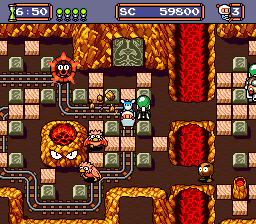
Each world in Bomberman ’94 feels less like a generic level and more like a carefully curated gauntlet of thematic misery—and I mean that in the best way possible. Hudson Soft really flexed their creative muscles here, moving away from the “square room with some bricks” aesthetic to embrace more elaborate, sprawling structures.
The stages are larger and often split by doors, forcing you to treat each area like a mini-dungeon. One minute you’re breezing through a meadow, and the next, you’re trapped in a mechanical nightmare wondering who designed these deathtraps.
Area Two isn’t content with just having enemies; it uses the background itself as a weapon. Volcanic vents periodically erupt, launching stray fireballs onto the playfield that can stun poor White Bomberman right in his tracks. Getting stunned is essentially a death sentence if a bomb is ticking nearby. You have to develop a sort of rhythmic movement, constantly keeping one eye on the floor and the other on the sky.
If you thought the fireballs were bad, wait until the lights go out. Area Four plunges the player into shrouded darkness, severely limiting your line of sight. This changes the fundamental “vibe” of the game from an arcade blast-athon into a tense, almost survival-horror experience.
It’s the kind of level design that makes you hold your breath. One wrong turn into a dark corner and—pop—there goes your last life. Is it frustrating? Absolutely. But does it make the eventual exit feel like a genuine relief? You bet.
Area Five takes us to a frozen wasteland that is deceptively cute. Don’t let the igloos fool you; they act as cover for enemies, and you’ll need to blow the tops off just to see what’s hiding inside. It’s like a deadly game of Whac-A-Mole where the mole has a thermal detonator.
Then there are the Penguins. These aren’t your friendly Happy Feet variety; these guys launch rockets with free will. These projectiles track your movement, encouraging you to stay mobile or get caught in a very icy explosion. It’s a chaotic finale that demands every bit of skill you’ve picked up along the way. Honestly, getting out of Area Five without losing your cool is the ultimate gaming achievement.
Let’s get real for a second: this game can be a total jerk. While the randomly generated mazes keep the experience from ever feeling stale, they also introduce a level of “Nintendo Hard” frustration that’ll have you white-knuckling your controller. One minute you’re a master of demolition, and the next, the CPU decides it’s time for your unscheduled retirement.
I’ve lost count of how many times I’ve spent ten minutes meticulously building up my speed and blast radius, only to have it all stripped away because the game spawned an enemy right on top of my arrival point. It feels a bit like the game is playing a prank on you, doesn’t it? This “Hornet’s Nest” scenario is the ultimate test of your reflexes, but it can feel incredibly cheap when you lose a life through no fault of your own.
Graphics
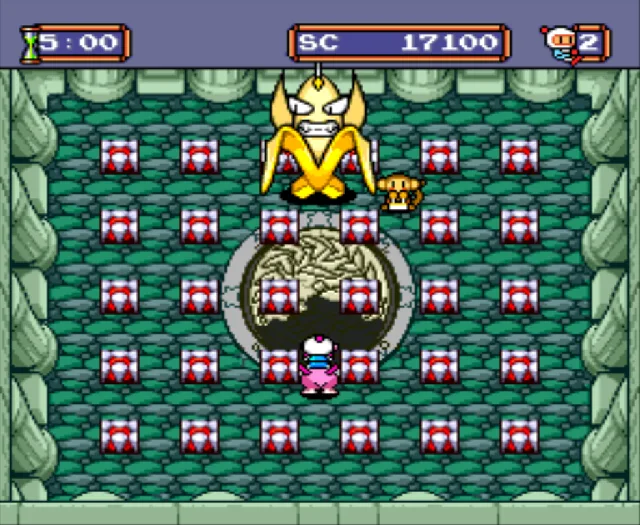
When you fire up Bomberman ’94, the first thing that hits you isn’t the smell of gunpowder—it’s the sheer visual feast. Hudson Soft clearly wanted to prove that the PC Engine wasn’t ready for the retirement home just yet. In fact, the graphics here are so polished that it’s easy to forget this hardware actually hit the market before the Genesis and the SNES.
The game runs with a buttery smoothness that makes the chaotic explosions feel visceral. It’s an impressive feat of optimization; even when the screen is filled with chain reactions and wandering enemies, the frame rate rarely hitches.
The developers utilized the system’s expansive color palette to create environments that feel deep and layered. Ever noticed how the lighting seems to change between different areas? That’s not an accident. Hudson’s wizards used every trick in the book to ensure Bomberman ’94 looked like a next-gen title on last-gen silicon.
Forget the flat, repetitive tiles of yesteryear. The floor textures in this entry are incredibly detailed, featuring everything from cracked volcanic rock to shimmering ice. It adds a sense of place to the mayhem, making you feel like you’re actually trekking across a shattered planet rather than just navigating a digital grid.
The sprites are punchy and pop against the backgrounds, which is a lifesaver when things get hectic. The game looks every bit as good as a flagship Super Nintendo title, boasting a level of artistic maturity that the earlier games lacked. It’s a testament to the hardware’s longevity and showcased the PC Engine’s unique ability to handle high-speed action without breaking a sweat. Whether you’re watching the lush background elements scroll by or marvelling at the massive, screen-filling bosses, the game never fails to impress.
Final Verdict
Bomberman ’94 is a fragmented masterpiece in more ways than one. While it literally tasks you with mending a broken world, the experience itself is split between sheer arcade bliss and genuine, hair-pulling frustration. It’s a relatively short experience, but the problem is that the “sour” moments—like losing your entire inventory to a psychic penguin—can make that short runtime feel much longer than it actually is.
If you decide to go the emulation route, you gain the ultimate superpower: the save state. This completely negates the password problem and allows you to practice those brutal boss patterns without replaying the entire area. For those who want a more “official” modern experience, Bomberman ’94 saw a fantastic release on the PlayStation Network (under the PC Engine Classics banner). These versions usually bundle in basic save functionality, giving you the best of both worlds.
Despite its quirks, it’s impossible to deny the impact this title had on the series’ DNA. By introducing Bagura and the multi-part level structures, Hudson Soft moved the needle from simple maze game to legitimate adventure. If you want to experience the game that truly defined the modern Bomberman formula, Bomberman ’94 is still worth experiencing today.
Verdict
Bomberman ’94
Good

At HyperComboGamer, we believe great games deserve great coverage. That means no filler, no clickbait, or fanboyism—just honest, high-quality reviews, features, and guides that put gamers first. Whether you’re a lifelong enthusiast or just starting your gaming journey, you’ll find interesting gaming perspectives that will leave you fully satisfied.