Imagine your favorite developer suddenly vanishes into a cloud of debt and bankruptcy. That’s exactly what happened to the legendary shmup house Toaplan in the mid-90s. But out of those smoldering embers, a group of resilient veterans forged a new entity: Cave. Their first project, DonPachi, became an instant hit in Japanese game centers, eventually landing on the Sega Saturn and PlayStation.
Despite the commercial success and fan adoration, main programmer Tsuneki Ikeda viewed DonPachi as a creative failure that missed the mark entirely, and felt that the team leaned too heavily on old tropes rather than carving a new path. While searching for a new direction, the team found inspiration in a rival’s masterpiece: Raizing’s Battle Garegga. That game’s relentless intensity and complex rank systems provided the “aha!” moment Cave desperately needed.
In 1997, Cave unleashed DoDonPachi onto the arcade world. Would this new venture finally step out from the Toaplan shadow and claim its own bloody throne? In this review, you’ll find out whether DoDonPachi still provides a bullet storm of excitement today.
Gameplay
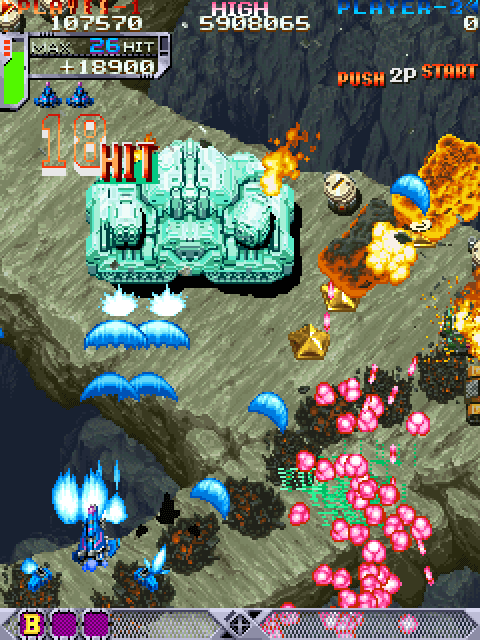
DoDonPachi’s gameplay is absolutely bonkers. You’ll come across a literal ton of enemies on the screen at once, and the bosses show absolutely no mercy. They spray a colorful, kaleidoscopic number of bullets that will test your gaming reflexes to their absolute limit.
You only need an eight-way joystick and two buttons to pilot your craft through this mechanical nightmare. While modern games clutter the screen with complex inputs, DoDonPachi keeps things elegantly simple. You move, you shoot, and you pray your thumb doesn’t slip during a frantic dodge.
Does simplicity mean the game lacks depth? Far from it. The beauty lies in how Cave utilizes those limited inputs to create a high-stakes dance of death. You’ll spend your time weaving through neon-colored curtains of fire while managing your offensive options with surgical precision.
The A button handles your primary offense, but it functions differently depending on your rhythm. Tapping the button releases a standard salvo of shots that covers a wide area of the screen. This works perfectly for sweeping away the “popcorn” enemies that clutter the early stages.
However, the real game-changer involves holding the A button to fire a concentrated laser. This beam tears through tougher enemies and bosses with terrifying efficiency. Best of all, it removes the need for carpal-tunnel-inducing button mashing found in older shmups. FYI, this laser also slows your ship down slightly, giving you the fine-tuned movement needed for pixel-perfect dodging.
Sometimes the screen fills with so much colorful bullets that you just need a “get out of jail free” card. That’s where the B button comes in. Pressing it solo unleashes a massive Spread Bomb that incinerates everything in its radius and clears the air of enemy fire.
But wait, there’s a tactical twist for the pros. If you press B while holding your laser (A button), you trigger a Laser Bomb. This focused blast deals catastrophic damage to whatever is directly in front of you while granting temporary invincibility. Who doesn’t love a few seconds of being an untouchable god of destruction?
Do you have the nerves to hoard your explosives while neon death swarms the screen? Most players panic and mash the B button the second a stray bullet gets cozy with their hitbox. But the real pros know that collecting a “B” icon when your bomb stock is full rewards you with a cool 10,000 points and triggers the MAXIMUM bonus.
This state turns your score counter into a caffeinated stopwatch that ticks upward relentlessly. You basically enter a high-stakes game of chicken with the arcade cabinet. Is that soaring score worth the risk of a pixel-perfect collision?
Every mechanical monstrosity you obliterate leaves a glittering trail of debris in its wake. Defeating enemies and leveling buildings scatters various types of stars across the battlefield. You must pick up these stars to boost your score both instantly and at the end of the stage.
Regular stars dropped by standard enemies offer a pittance of 100 points initially. However, if you survive until the end of the level, the game magnifies their value by five times when calculating your final tally. It’s like a tiny, violent savings account that pays out massive dividends if you don’t go bankrupt by exploding.
Not all celestial debris is created equal, and knowing what to prioritize is the difference between a local high score and global dominance. Badge stars, often found by dismantling scenery, are worth 300 points or even 1,000 for specific structures. Ever felt that rush of dopamine when a massive building collapses into a shower of gold?
The real prizes, however, come from the heavy hitters. Taking down colossal enemies or stripping the armor off a boss rewards you with Big Stars worth over 10,000 points. These are the “must-grabs” that define a legendary run. IMO, ignoring these is basically leaving free money on the table.
Here is the catch that keeps shmup fans awake at night: dying resets your star progress. If you take a bullet to the face, you’ll be starting again from zero with those bonuses. It’s a brutal system that punishes credit feeding and rewards pure, unadulterated skill.
While your eyes might widen at the chaos, the secret to survival isn’t just raw reflex—it’s pattern recognition. The game gets significantly easier once you memorize the enemy formations and the specific “lanes” through the bullet curtains.
Graphics
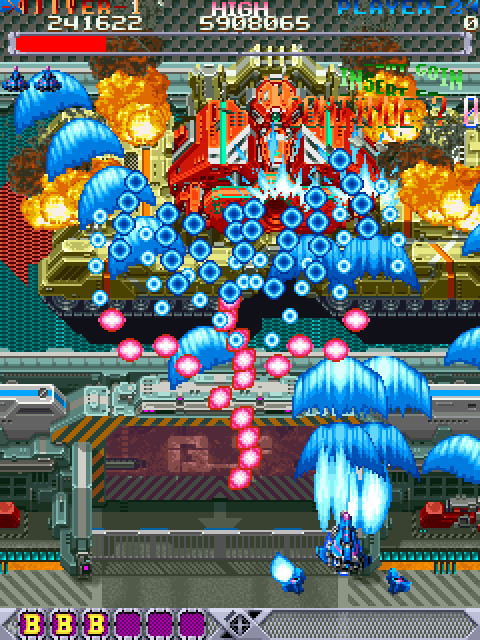
The graphics in DoDonPachi are a legitimate sight for sore eyes, especially if you’re a fan of the 32-bit era’s peak 2D aesthetic. Every sprite feels heavy and tangible, boasting pixel art so detailed it puts modern retro-style games to shame. I love how every enemy, from the smallest drone to the screen-filling behemoths, features gobs and gobs of fluid animation.
Have you ever noticed how the mechanical designs actually look functional? Turrets rotate with a satisfying mechanical crunch, and wings tilt as ships bank into view. It’s this attention to detail that elevates the experience from a simple shooter to a living, breathing war zone.
The carnage doesn’t just happen in a vacuum; the backgrounds are just as exquisitely detailed as the enemies themselves. You’ll fly over lush forests, scorched industrial complexes, and futuristic cityscapes that feel incredibly immersive. The layering and scrolling effects create a sense of scale that makes you feel like a tiny speck in a massive global conflict.
Cave didn’t just stop at “pretty,” though. The color palette is carefully chosen so that the enemy bullets pop against the grittier scenery. This isn’t just an artistic choice—it’s a survival necessity when the screen gets busy!
Final Verdict
Let’s face it: DoDonPachi’s difficulty level can be absolutely off the charts. If you aren’t a seasoned shmup veteran, you’re going to see the “Game Over” screen. A lot. And to make matters worse, the game technically ends way too soon! Regardless of how many times you die, this game is so incredibly good that you’ll always come back for more.
At the end of the day, there are shmups, and then there’s DoDonPachi. This wasn’t just a sequel that was better than its predecessor; it was a tectonic shift that changed the bullet hell genre forever. It proved that you could have screen-filling chaos without sacrificing fair, pattern-based gameplay.
While the steep challenge might scare off the faint of heart, those who stick with it will find one of the most rewarding experiences in arcade history. It’s loud, it’s vibrant, and it’s undeniably brilliant. If you have any love for 2D shooters, this is a mandatory play.
Verdict
DoDonPachi
Great