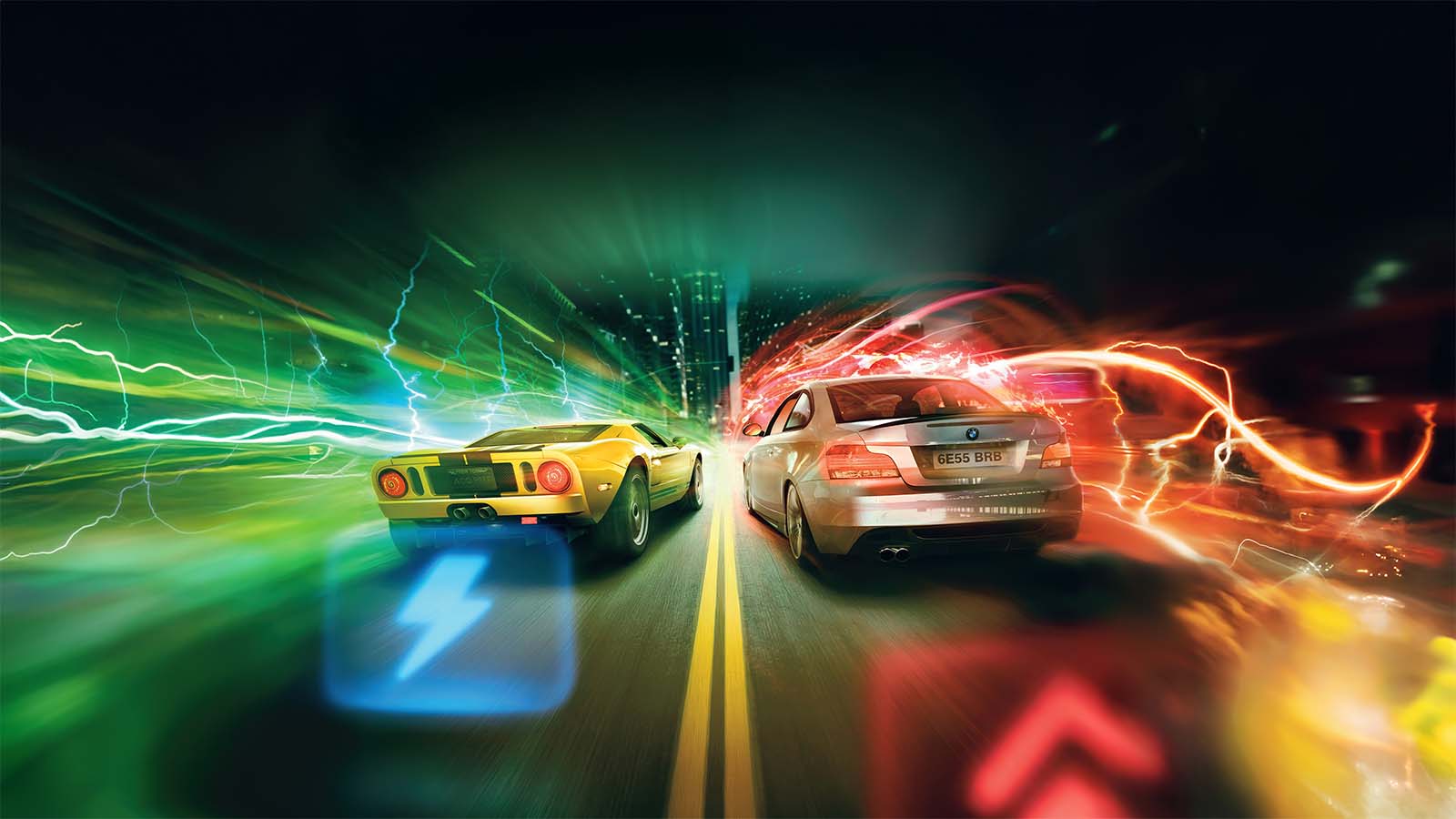
Have you ever wondered what would happen if you took Need for Speed and mashed it with Mario Kart? You get Blur, a supercharged arcade racer that overflows with power-ups and high-speed thrills. Developed by the wizards at Bizarre Creations, does this mashup actually hold up, or is it just a messy collision of ideas? In this review, you’ll discover whether Blur still deserves a spot on your gaming backlog today.
Campaign
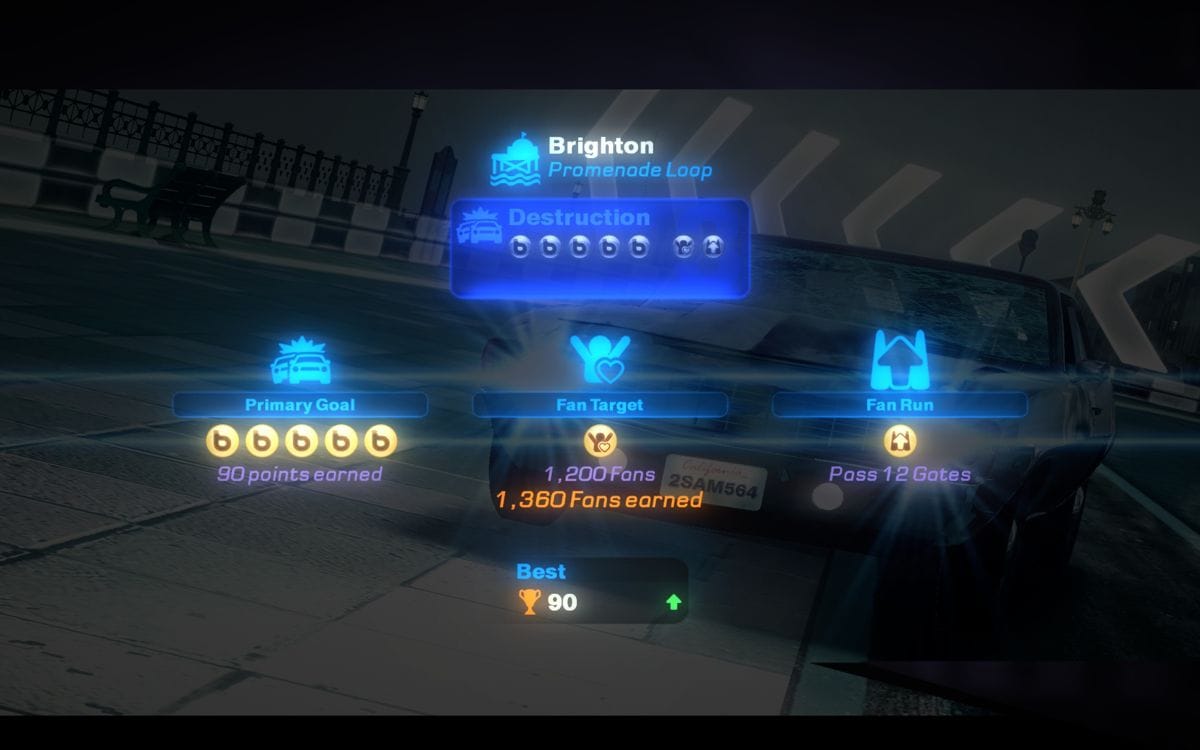
The career mode in Blur isn’t some bloated, cinematic drama with C-list actors pretending to be your rival. It’s a pure, unadulterated street racing grind that values one thing: performance. You start at the bottom of the scrap heap with a handful of basic cars and zero street cred, forced to claw your way through a hierarchy of nine distinct racing “fan groups.”
Winning a race is one thing, but doing it with enough flair to make the crowd lose their minds? That’s where the real progression lies. In Blur, Fans are the ultimate currency, acting as a direct evolution of the “Kudos” system Bizarre Creations perfected in their Project Gotham Racing days. You don’t just move up the ladder by being fast; you move up by being a total show-off.
Every action you take on the track—from a perfectly timed Nitro boost to a precision Bolt hit—feeds into your Fan Meter. The game constantly tracks your Fan Demands—mid-race challenges like drifting through a specific gate or hitting a target with a certain power-up—that force you to stay aggressive. It’s a brilliant way to ensure you never just “coast” in first place.
Each event dangles seven primary Lights in front of your bumper, and grabbing all of them requires a level of multitasking that would make a fighter pilot sweat. You get five Lights for a first-place podium finish—the bread and butter of any racer—but those final two are the real tests of a street racing legend.
One is tied directly to your Fan Target, and the other is the Fan Run, a localized slalom that triggers mid-race and demands you weave through glowing gates without losing your position.
To reach the top, you have to go through the bosses. Each of the game’s nine tiers culminates in a one-on-one showdown against a lead racer. But here’s the catch: you can’t even challenge them until you’ve met a specific set of criteria, like earning a certain number of fans or successfully landing a specific number of Longshot bolt hits.
Beating these bosses is arguably the most rewarding part of the single-player experience. Why? Because you actually take their customized car as a trophy. These Boss Cars aren’t just reskins; they come with unique stat boosts and tuned performance that give you a serious edge in the next tier.
Vehicle Roster
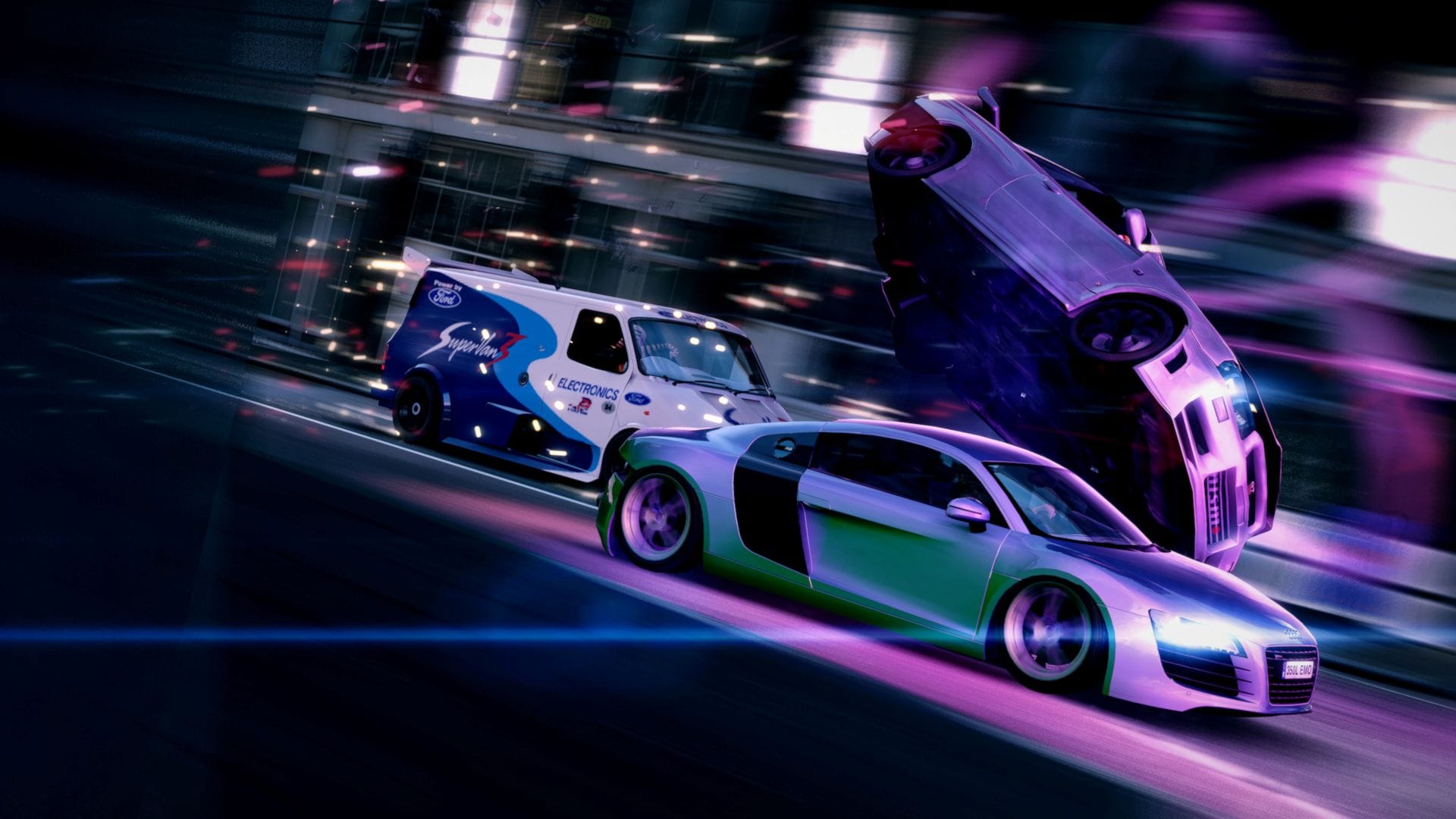
Forget those generic, legally-distinct “supercars” you see in other arcade titles. Blur brings the heavy hitters to the party with over 55 licensed vehicles that look stunning even by today’s standards. Seeing a real-world Audi R8 or a Ford GT hunkered down on a neon-lit track feels inherently correct, providing a grounded contrast to the pink energy bolts flying past your windshield.
The garage isn’t just a collection of pretty shells, either. In the world of Blur, your choice of ride dictates your entire survival strategy. Do you want a car that hugs the corners like it’s on rails, or are you looking to get sideways and flashy? Bizarre Creations split the handling physics into two distinct schools of thought: Grip and Drift. It’s not just a cosmetic preference; it’s a fundamental choice between stability and fan-service.
Grip cars are the precision instruments of the garage. If you’re piloting a Lotus Exige or an Audi R8, you’re playing a game of lines and late braking. These cars refuse to budge, allowing you to weave through a chaotic mess of Shunt pulses and dropped Mines with surgical accuracy. They are arguably the sweatier choice for players who want to win through pure driving discipline.
On the flip side, we have the Drift cars. If you’ve ever wanted to turn a Shelby GT500 into a smoke-billowing ballerina, this is your lane. Sliding isn’t just for show here; it’s the fastest way to rack up Fans. The more airtime and sideways momentum you maintain, the faster you rank up. Is it the most efficient way to take a hairpin? Maybe not. Is it the most stylish? Absolutely.
Ultimately, finding your soulmate in the garage is half the fun. You might start the campaign thinking you’re a Grip purist, only to find that the sheer adrenaline of a 200 MPH power-slide in a Nissan 350Z is too addictive to ignore. IMO, the best way to play is to keep a balanced stable—because sometimes you need a scalpel, and sometimes you just need a sledgehammer.
Gameplay
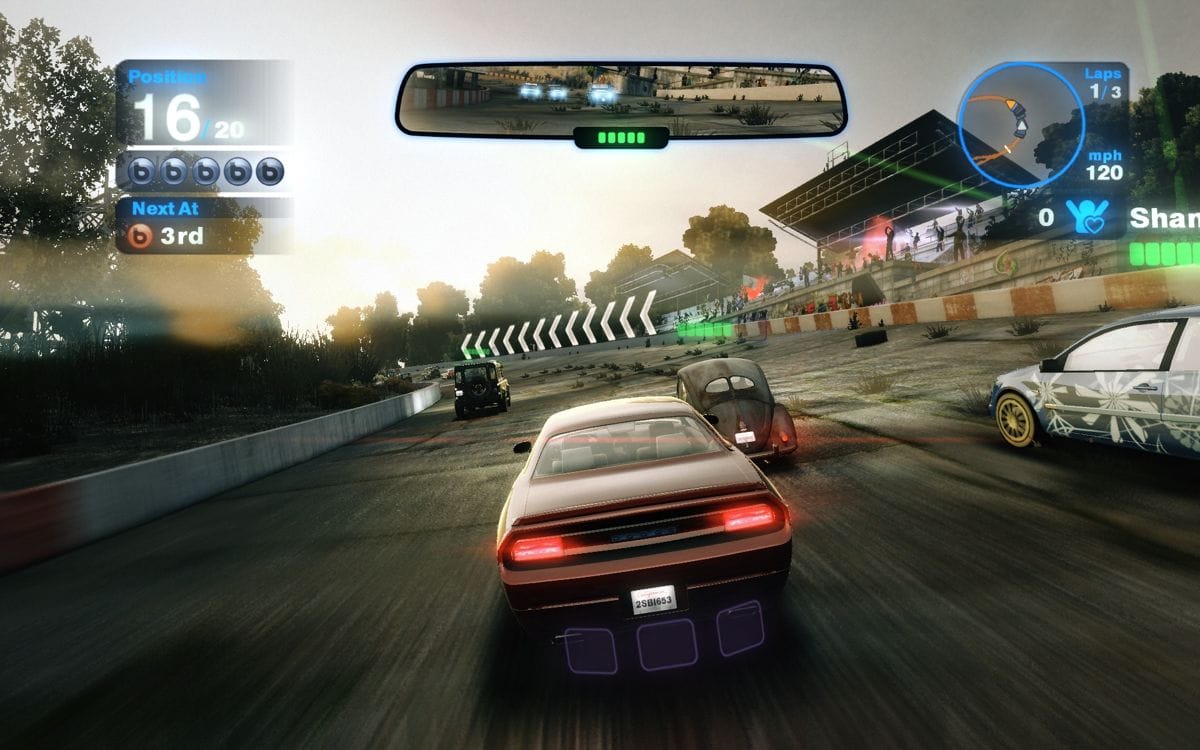
Blur isn’t just about driving well; it’s about resource management at 200 MPH. With eight distinct abilities scattered across every track as fixed pickups, the game removes the RNG frustration of kart racers and replaces it with pure, calculated aggression.
The Barge is a localized shockwave that pushes nearby cars away from you. It’s the perfect tool for those crowded hairpins where everyone is fighting for the same inch of asphalt. The Nitro not only provides the expected speed boost, it also doubles as a defensive maneuver.
If you’ve ever felt the pure, unadulterated rage of a Blue Shell hitting you inches from the finish line, let me introduce you to its street-legal nightmare: the Shunt. This glowing orb of kinetic energy is essentially a heat-seeking missile that flips your car like a pancake, and honestly, seeing one in your rearview mirror is enough to trigger a legitimate fight-or-flight response.
While the Shunt is the heavy-handed sledgehammer of the Blur arsenal, the Bolts are the high-speed scalpels. You get three shots of these neon pink energy spikes, and unlike the Shunt, they have zero homing capabilities. You have to aim these manually, which turns a standard straightaway into a high-stakes shooting gallery.
Then we have the Shock, which is arguably the most Mario Kart-esque weapon in the game, yet it feels entirely unique. Instead of a projectile that travels along the track, the Shock teleports three massive domes of electrical interference directly into the path of the person in 1st place. If you’re the one in the lead, hearing the Shock activation is a nightmare.
The Shield and Repair power-ups are the most important resources in your three-slot inventory, because it not only protects you from powerful Shunts but it repairs any damage your car received during the race. Since you can only hold three items, keeping a Shield on deck means you only have two slots for offensive mayhem. It’s a constant trade-off between being a glass cannon or a rolling fortress.
Graphics & Sound
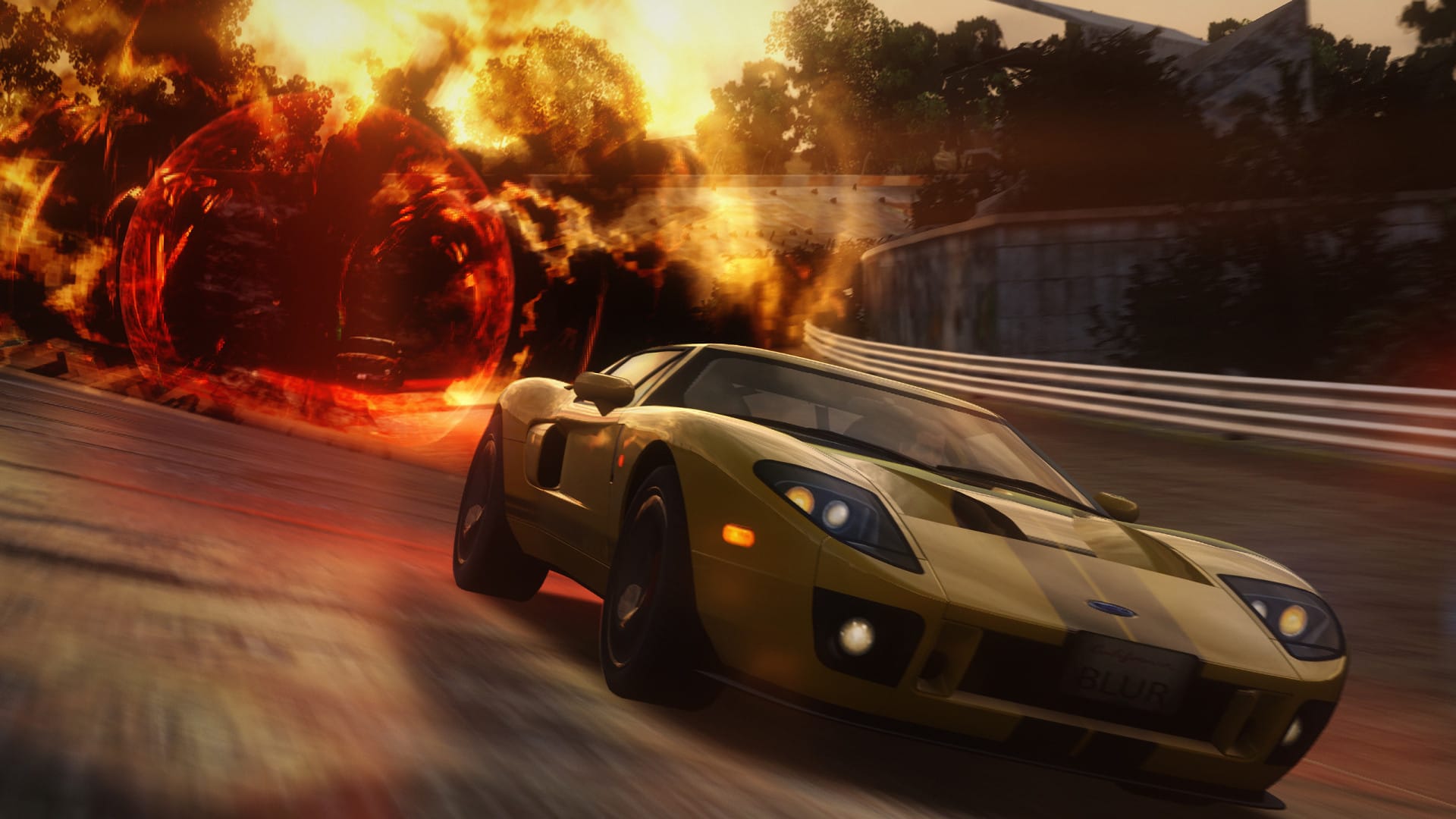
Bizarre Creations ditched the sterile, sun-drenched look of typical racers for a high-energy visual style that feels like a 4K rave on wheels. Every race is a neon-soaked fever dream where the rain-slicked asphalt of London and the glow of Tokyo’s skyscrapers act as a canvas for absolute digital carnage.
The game doesn’t just look “good”; it looks electric. Every collision sends a shower of sparks across the track that lingers just long enough to obscure your vision, adding to the frantic tension. True to its name, the motion blur and depth-of-field effects at 200 MPH create a sense of speed that is genuinely terrifying.
While the game was a looker back in 2010, seeing Blur running in 4K resolution today is a revelation. The textures on the licensed cars hold up remarkably well, but it’s the lighting that steals the show. The way the purple glow of a Shunt illuminates the underside of a bridge as it whistles past your ear is nothing short of breathtaking. It’s arcade in the best sense—exaggerated, vibrant, and unapologetically loud.
The sense of speed here is ridiculous; it feels like your car is constantly on the verge of vibrating apart. When you hit a Nitro boost, the camera pulls back, the edges of the screen stretch, and the audio tunnels out, leaving you with nothing but the roar of the engine. If you’ve ever wanted to know what it feels like to drive through a 130-BPM laser light show, Blur is your ticket.
The sound design deserves its own trophy, too. The roar of a Corvette ZR1 engine isn’t drowned out by the music; instead, they mix together into this mechanical symphony of destruction. You’ll hear the whine of a power-up charging behind you over the thumping bass, creating a layer of tension that keeps your heart rate in the triple digits. FYI, the way the audio muffles slightly when you activate a Shield is a chef’s kiss level of detail.
A game this visually loud needs a soundtrack to match, and Bizarre Creations absolutely delivered. Featuring heavy hitters like The Qemists, Coldcut, and The Heavy, the music is a masterclass in high-energy curation. The tracks perfectly complement the mechanical rhythm of the racing, blending breakbeat, electronic, and rock into a pulse-pounding backdrop for your destruction.
Plus, there’s a super thoughtful feature to toggle off the licensed music, which is a total lifesaver for content creators today who want to share their gameplay without getting slapped by copyright bots. Why don’t more modern games make this a standard?
Replay Value
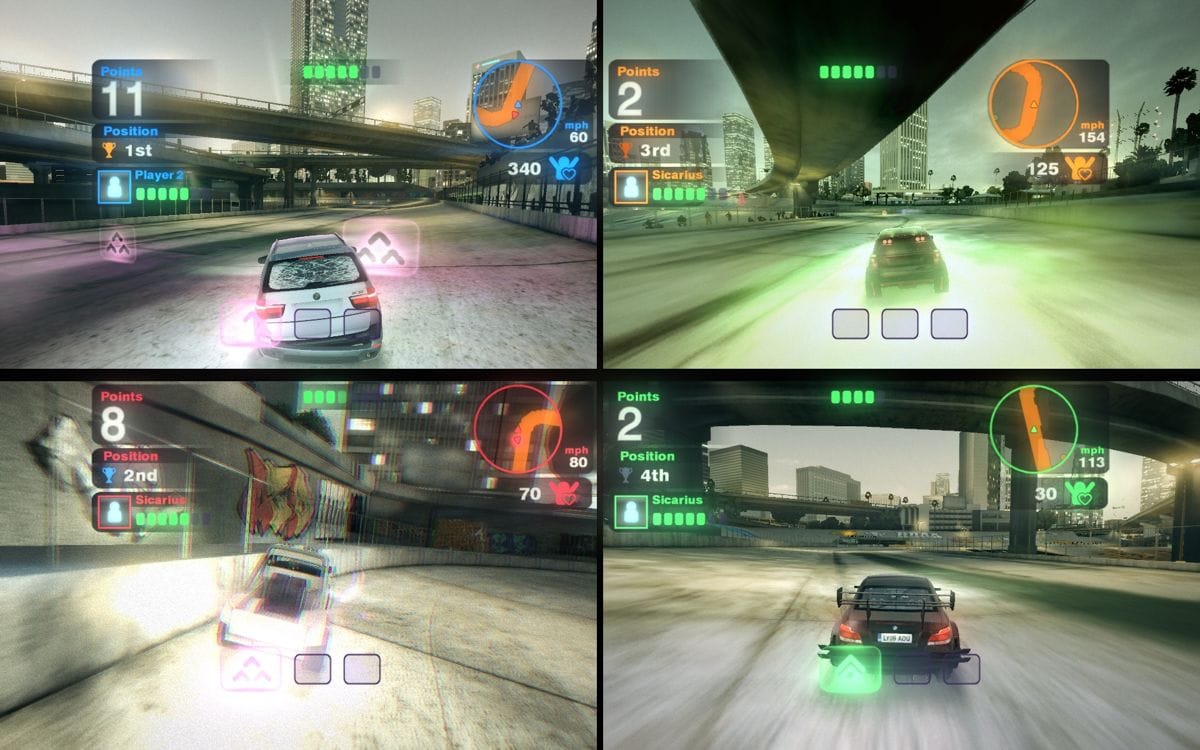
Back in 2010, while most games were struggling to keep eight players synced without teleporting them into the stratosphere, Bizarre Creations was hosting 20-player multiplayer riots. You aren’t just worried about the guy in first; you’re worried about the nineteen other lunatics trying to occupy the same square inch of Barcelona asphalt. It’s glorious, beautiful, and utterly terrifying carnage.
Blur’s official servers may be a memory, but the game refuses to die. Why? Because Bizarre Creations had the foresight to include LAN support. In an age where always-online requirements turn games into expensive paperweights the moment a studio closes, Blur remains fully playable with your friends. Why can’t more racing games add this awesome feature again?
Because Bizarre Creations had the foresight to keep local networking in the code, the community hasn’t just survived—it’s thrived. Fans have built custom launchers and tunneling software that trick the game into thinking your buddy three states away is sitting right next to you on the couch. Thanks to LAN, Blur is essentially immortal.
Final Verdict
It’s impossible to talk about Blur without addressing the massive elephant in the room. Shortly after Blur hit shelves, Activision pulled the plug on Bizarre Creations in 2011. Blur was a bold, expensive risk that unfortunately launched in a crowded market alongside heavy hitters like Split/Second and ModNation Racers. It’s a tragic reminder of how ruthless the AAA gaming industry can be.
So, after all these years, does Blur still hold up? Absolutely. Between the crisp visuals, the high-energy soundtrack, and a combat system that rewards genuine strategy over random luck, Blur is an extremely fun and addictive racing game. While it’s a tragedy that we never got a proper sequel, Bizarre Creations truly left on a high note, and their final gift to us is a game that still feels fresh, fast, and fiercely competitive today.
Verdict
Blur
Excellent