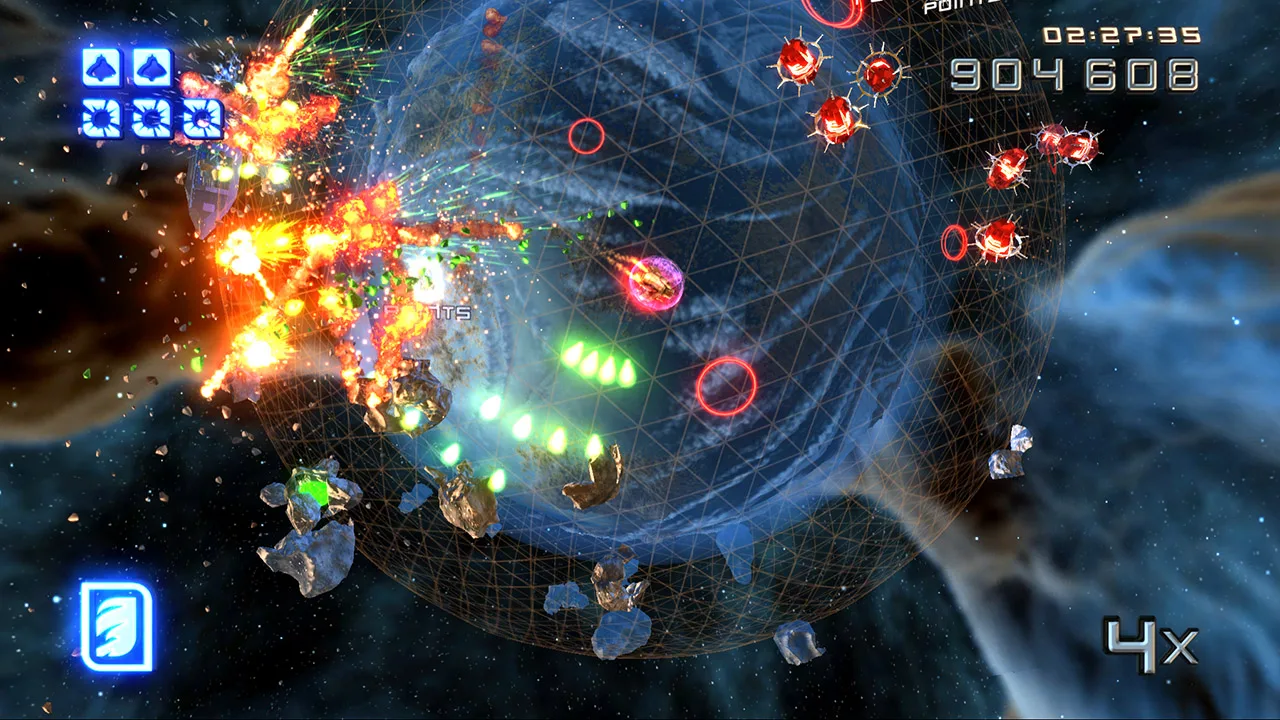
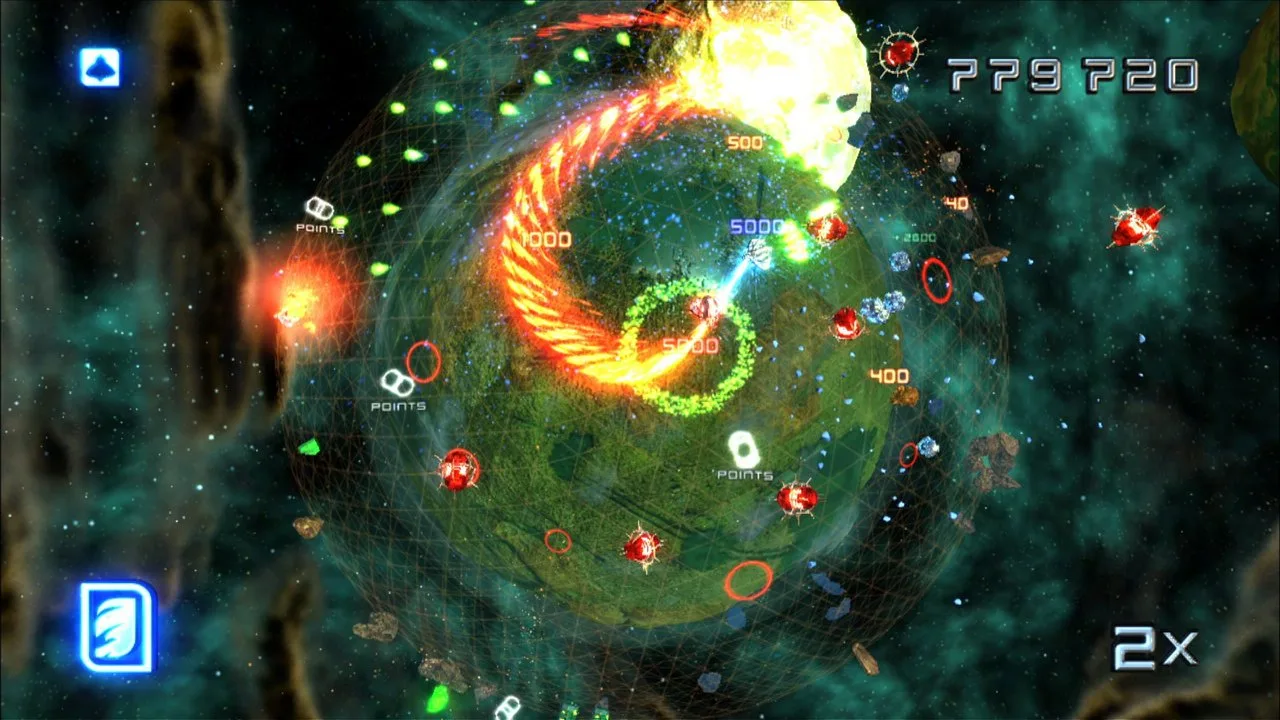
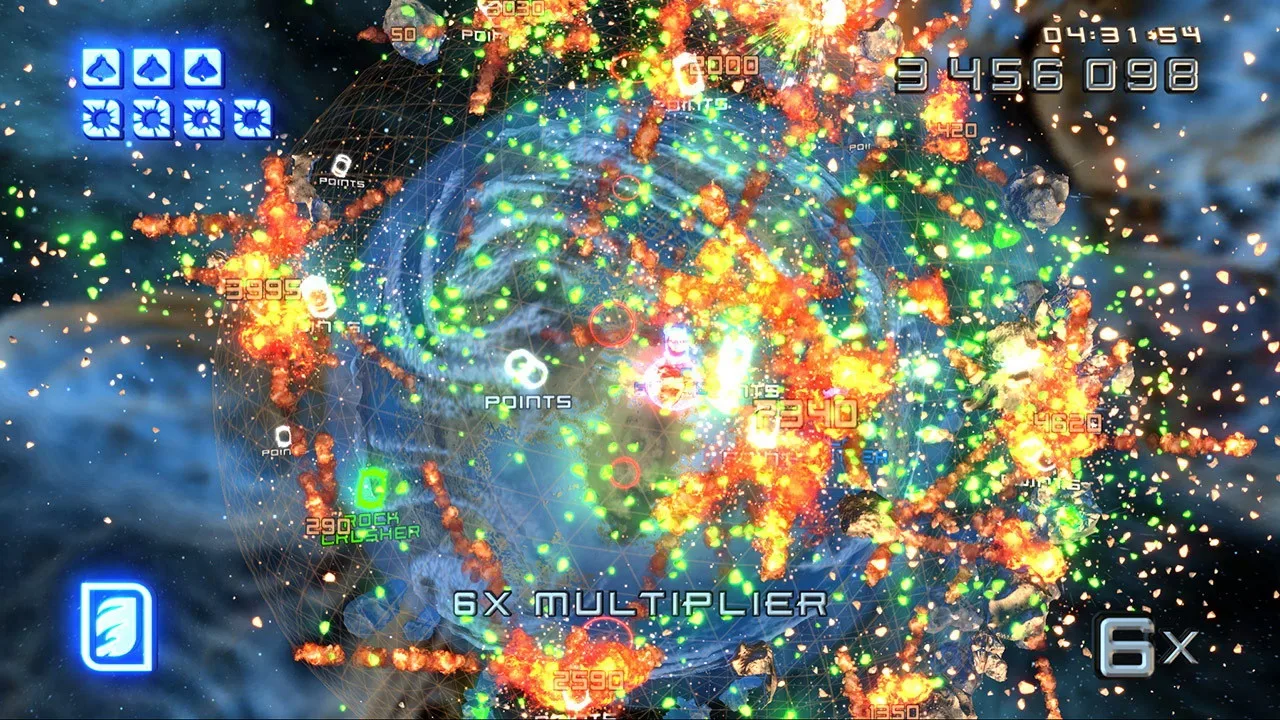
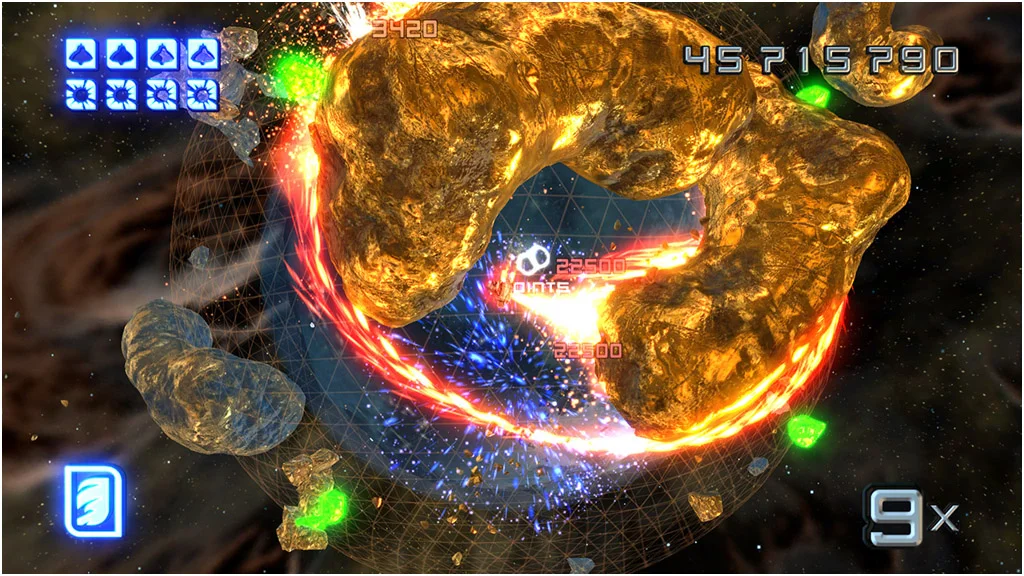
Visual Perfection: Runs at a flawless 60 fps in 1080p, looking crisp even by today’s standards.
High Entry Barrier: The difficulty spikes fast, which might frustrate more casual players.
Deep Tactics: Three distinct weapon types mean you aren’t just spraying and praying; you’re planning.
Sparse Lives: You don’t get many “do-overs,” making a single mistake feel pretty devastating.
Satisfying Feedback: Every asteroid you shatter feels amazing thanks to great sound and particle effects.
Chaotic Screen: When the action peaks, it can occasionally be tough to track your own ship.
DLC Variety: Modes like Bomber and Endless add dozens of hours of replayability beyond the main game.
Controller Wear: Your dual-analog sticks (and thumbs) are going to take a serious beating.
Eugene Jarvis practically handed us the keys to the twin-stick kingdom when he birthed Robotron: 2084 in the early eighties, which was a frantic exercise in sensory overload that demanded total ambidextrous mastery. The original Super Stardust dazzled the Commodore Amiga crowd with its state-of-the-art visual kineticism. It took the DNA of Asteroids and injected a lethal dose of power-ups and hostile armadas.
Years later, Geometry Wars: Retro Evolved single-handedly resuscitated this forgotten genre on the Xbox 360. It proved that gamers still craved high-octane chaos over complex narratives. The Finnish wizards at Housemarque resurrected a venerable relic as Super Stardust HD, promising 1080p visuals for a new generation of trigger-happy pilots. Does this remake still provide that frantic dopamine hit, or should it remain a ghost in the machine? In this review, you’ll discover whether this interstellar demolition is still worth playing today.
Gameplay
The campaign throws you headfirst into a meat grinder across five distinct planets. Each world contains five ‘phases,’ totaling 25 levels of escalating insanity. You won’t find a bloated narrative or pretentious cutscenes here to slow down the rhythm.
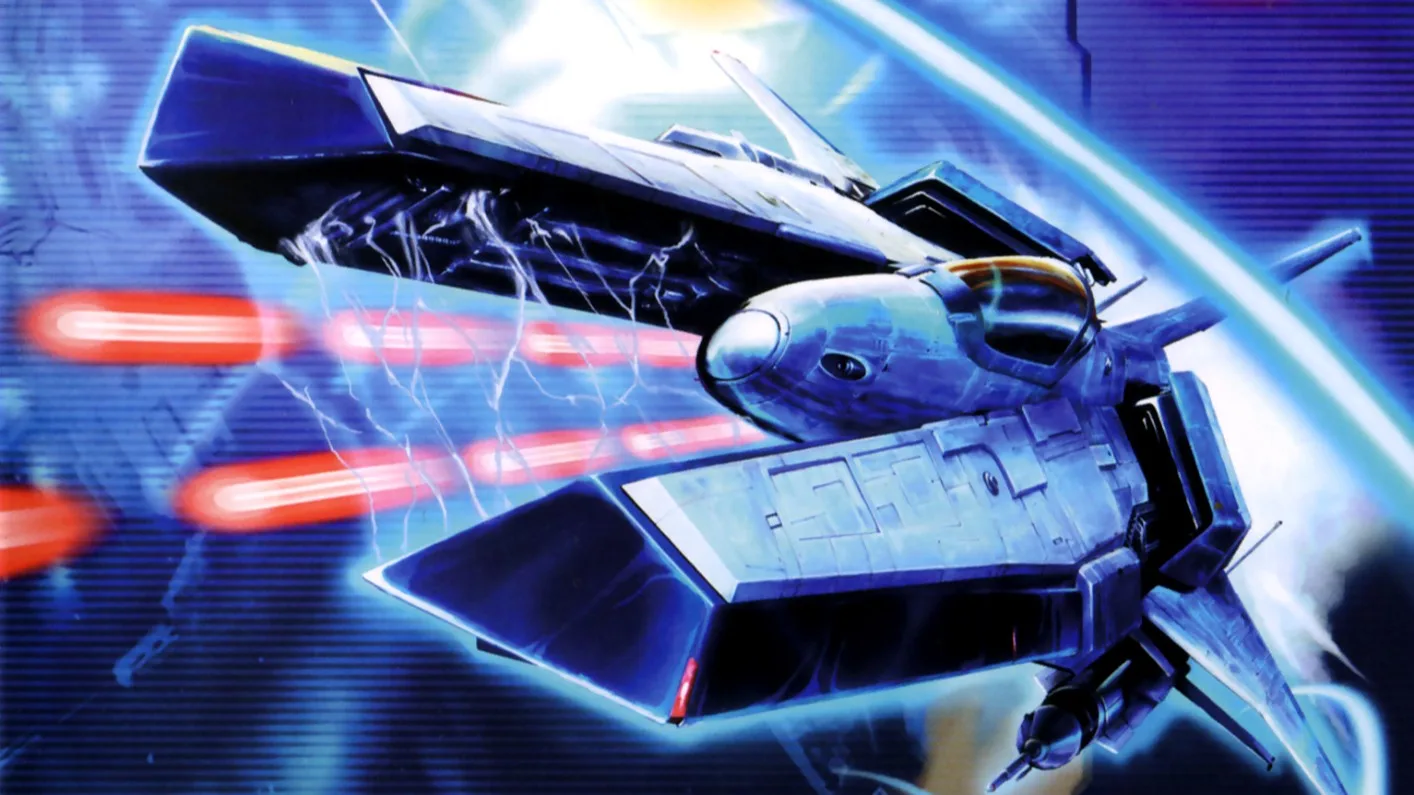
Stardust HD focuses entirely on the symbiotic relationship between you and the analog sticks. You navigate your ship around a spherical battlefield, shooting through thousands of interstellar rocks and bizarre alien invaders. It sounds simple, right? Don’t let that initial minimalism deceive you; the mechanical depth here requires genuine strategy.
You might think a twin-stick shooter is just about holding down the trigger and praying. In Super Stardust HD, that’s a one-way ticket to a fiery space-grave. Success depends on your ability to juggle three primary weapon systems on the fly. The green Rock Crusher laser obliterates standard debris, while the Gold Melter flamethrower carves through orange ore like butter. If you encounter blue ice, you’ll need the Ice Splitter shard gun to survive the onslaught.
It’s a constant mental juggle: Do I swap to the Gold Melter for this incoming swarm, or stick with the Rock Crusher to clear a path through the debris? This layer of elemental strategy transforms the game from a simple twitch experience into a thinking man’s arcade gauntlet. It’s stressful, it’s frantic, and it’s arguably the most addictive thing you can do with a DualShock 3.
The control scheme feels remarkably intuitive, even during the most frantic moments of a high-score run. You swap between these elemental killers instantly by flicking the L1 or R1 triggers. Need a quick escape or a final hail mary? Tap L2 or R2 to trigger your thrust feature or drop a screen-clearing Mega Bomb. IMO, the tactile response of these weapons makes every explosion feel personal.
Don’t go into this expecting a participation trophy. Housemarque hates your comfort zone, and they show it by making extra lives notoriously sparse. You start with a meager handful, and earning more requires a level of precision that would make a surgeon sweat. If you want to conquer all five planets without seeing that mocking “Game Over” screen, you’re going to need to practice until your thumbs ache.
Is the steep difficulty curve a dealbreaker? Not even close. Every death feels like a lesson rather than a cheap shot. The game rewards your growing skill with incredibly satisfying explosions and boss battles that feel like genuine events. There is a primal joy in finally cracking a difficult phase that few modern shooters can replicate.
Graphics
Back in 2007, we were all obsessed with seeing what “Next Gen” actually looked like. Super Stardust HD acted as the poster child for the PS3’s raw power, delivering a presentation that still looks remarkably crisp. We’re talking a native 1080p resolution running at a silky 60 fps without so much as a hiccup.
Ever seen a game engine choke when the action gets crowded? Not here. Even when the screen is jam-packed with enemy spacecraft and a meteor storm’s worth of unexploded asteroids, the framerate stays locked. It’s the kind of optimization that makes you wonder why some modern titles still struggle to hit these targets.
The aesthetic isn’t just about high resolutions; it’s about the vibrant soul of the presentation. Every object—from a massive, planet-cracking rock to the tiniest shard of space dust—is perfectly lit and beautifully animated. The way light bounces off your ship’s hull as you weave through a kaleidoscope of projectiles is pure eye candy.
The power-up weaponry creates a light show that would make the legendary developers at Treasure (the wizards behind Ikaruga) nod in approval. When you let a Mega Bomb rip, the resulting particle physics and explosive effects are breathtaking. It’s a masterclass in visual feedback—you don’t just see the destruction; you feel the weight of it. 🙂
Super Stardust HD presents a visual masterclass that still manages to embarrass many modern indie efforts with its sheer technical moxie. Every single celestial body, from the planet-cracking behemoths to the microscopic grit, catches the light with a shimmering, realistic glow.
Remember those legendary Treasure shooters where the screen resembled a psychedelic firework factory more than a video game? This game channels that exact effulgent energy but cranks the fidelity to astronomical levels. The particle effects create a chaotic harmony of neon every time your laser connects with a stray rock. Seriously, how did they pack this much visual data into such a small download?
Ever wondered if your console might actually achieve sentience and revolt during a particularly heavy firefight? Most games from this hardware cycle would choke and stutter the moment more than ten enemies cluttered the screen. Yet, this title maintains its silky-smooth fluidity even when a meteor storm’s worth of unexploded asteroids fills the orbital plane.
Replay Value
If you thought the base game was a mountain of content, the Solo and Team DLC packs act like a massive gravitational pull, sucking you right back into the cockpit. These expansions don’t just add a coat of paint; they fundamentally rewire how you approach the orbital chaos. Housemarque essentially took the “more is better” philosophy and applied it with surgical precision to make sure your PS3 never gathers dust.
Ever wondered how long you could actually last if the universe stopped playing fair? Endless Mode answers that question by throwing a literal infinite wave of rocks and baddies at your face until you inevitably blink. It is the ultimate test of endurance and twitch-reflex muscle memory. The coolest addition here has to be the massive pyramid structures that occasionally warp into the playfield. Catching one of these in your sights is like finding a golden ticket.
If Endless feels like a marathon, Survival Mode is a sprint through a minefield while wearing a blindfold. It is easily the most punishing addition to the Stardust legacy. You get exactly one life to navigate a planet teeming with indestructible spheres that want nothing more than to end your run. It’s definitely as hard as it sounds, and my controller has the teeth marks to prove it
Then there’s Bomber Mode, which is a total brain-flip for veteran players. The game strips away your primary guns and disables your boost, leaving you with—you guessed it—only bombs. This forces you to fly with a level of strategic foresight usually reserved for grandmaster chess, detonating explosives to clear paths and hunting down supply ships for refills.
The Team Expansion finally brings your friends into the fold, though friends is a loose term once the Deathmatch mode starts. Sitting on the couch and screaming at your buddy during a high-stakes game of Grab and Run or King of the Hill is the peak PSN experience. For what it’s worth, there’s nothing quite like the saltiness of being the Last Man Standing while your friend watches from the sidelines.
To top it all off, the DLC packs introduce a revamped 5.1 surround sound Orchestra soundtrack. While the original synth-heavy tunes are iconic, the orchestral score gives the game a cinematic, blockbuster movie experience. Hearing the brass section swell as you dodge a planet-sized asteroid makes the whole experience feel fresh and incredibly epic.
Final Verdict
When I look back at my early days with the PS3, Super Stardust HD stands out as a definitive wow moment. It wasn’t just another digital download; it was a high-octane proof of concept for what high-definition gaming could actually achieve. Even years later, the sheer polish and intense feedback of every explosion make it hard to put the controller down.
Is it a walk in the park? Absolutely not. You will die, you will lose your multiplier, and you might even contemplate a brief vacation from your DualShock 3. However, the replay value is so high because the mechanics feel incredibly fair. With stunning 1080p visuals, epic sound design, and satisfying gameplay, Super Stardust HD is the pinnacle of twin-stick shooters. It’s polished, punishing, and quite frankly, a total blast.
At HyperComboGamer, we believe great games deserve great coverage. That means no filler, no clickbait, or fanboyism—just honest, high-quality reviews, features, and guides that put gamers first. Whether you’re a lifelong enthusiast or just starting your gaming journey, you’ll find interesting gaming perspectives that will leave you fully satisfied.